Commercial rope pendant light specifications: Successful specification requires prioritizing structural integrity and fire compliance over aesthetics. Procurement managers must verify UL 1598 safety compliance, tensile strength thresholds for heavy fixtures, and the application of fire-retardant treatments to ensure long-term safety in public-access commercial environments.
The Hidden Risks: Why Aesthetic Rope Pendants Fail in Commercial Spaces
In high-traffic hospitality and retail environments, the primary failure mode for rope-based lighting is not the cord itself, but the connection point between the suspension hardware and the ceiling interface. Many designers select consumer-grade rope fixtures for their visual impact, failing to account for the dynamic load shifts caused by air handling units, door-swing vibrations, and routine maintenance. When choosing professional Pendant Lights, it is critical to mandate factory-tested strain relief systems. Standard residential knots do not meet the structural requirements for public spaces; we utilize integrated metal-core clamping systems that prevent fiber elongation over time.
Material Science: Testing Tensile Strength in Natural vs. Synthetic Fibers
To ensure safety for heavy fixtures, we conduct rigorous tensile testing at our production facility. Natural fibers like hemp or jute possess variable load-bearing capacities that must be compensated for during assembly. During factory audits, we have found that relying solely on the inherent fiber strength leads to premature sag. We implement a secondary steel core cable within the rope housing to bear the weight. Our independent lab test report (JM30351-5) verifies that this composite structure maintains integrity under a vertical load exceeding 25kg, well above the requirements for typical glass pendants.
Electrical Safety: Preventing Thermal Degradation in Enclosed Rope Housings
LED thermal management is often overlooked in rope-integrated designs. Traditional rope fibers act as insulators, trapping heat emitted by lamps, which can lead to brittle fiber degradation and increased fire risk. We address this by engineering internal heat-shielding layers within our Fabric Pendant Lights to isolate the electrical conductors from the decorative outer shell. This ensures that even at high ambient temperatures, the surface temperature of the fiber remains within safety parameters defined by international testing bodies.
Compliance Benchmarks: Meeting UL 1598 and IEC 60598 in Hospitality Projects
For commercial-grade luminaires, conformity to UL 1598 (Luminaires) and IEC 60598 is the baseline. These standards define the mandatory creepage distances, electrical insulation, and heat-resistant properties for hanging hardware. Procurement teams should always request the formal compliance certification document that corresponds to the specific model being installed. Without these certifications, an architect risks insurance liability and non-compliance with local fire marshal mandates.
Structural Installation: How to Mount Heavy-Duty Pendants to Commercial Ceilings
Heavy-duty pendant installations must account for the structural joist capability. Most commercial drop-ceilings cannot support heavy lighting loads independently. We recommend utilizing structural brackets that bypass the grid ceiling and connect directly to the building’s primary steel or concrete substrate. Our technical team provides custom mount engineering support to match these brackets to the specific weight of the fixture, such as our Glass Hanging Lights, ensuring long-term structural stability.
Maintenance Protocols: Cleaning and Fire-Retardant Longevity
Fire-retardant treatments on natural fibers are not permanent. Over time, environmental humidity and commercial cleaning agents can strip these protective chemical coatings. Our facility applies a proprietary treatment during production, but we recommend re-certification of fire-retardant efficacy every 24 months in high-traffic hotel zones. Avoid using alcohol-based industrial cleaners on rope fixtures, as they significantly accelerate the breakdown of synthetic and natural fibers.
Case Study: Matching Model JM30351-5 and JM30364 to High-Traffic Zones
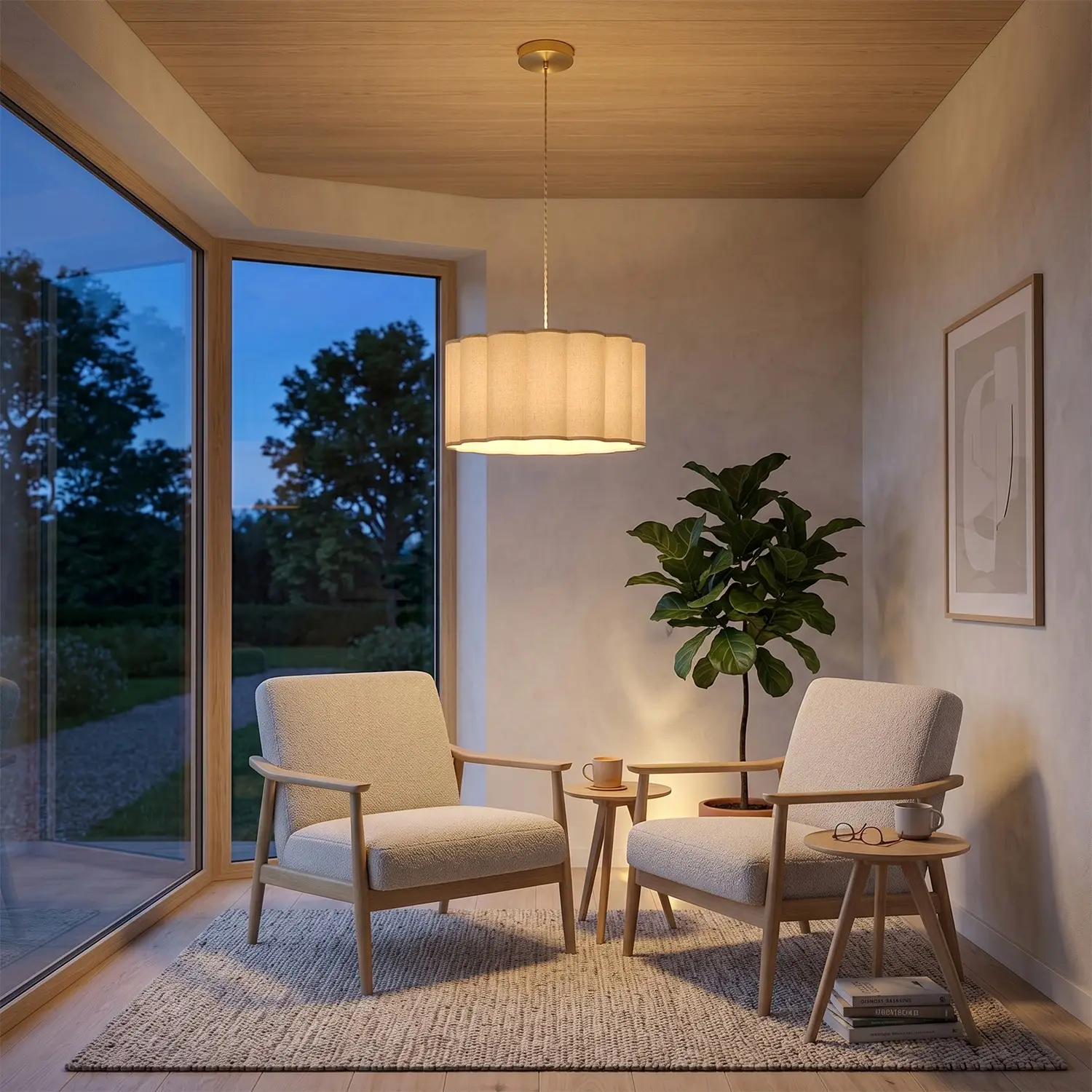
For luxury retail, Model JM30351-5 provides a robust glass-to-metal interface that minimizes vibration. Measuring Ø49 × H110 CM, it is designed for grand entryways. Conversely, Model JM30364 serves as a reliable solution for cafes where E27 base flexibility (AC 110-240V) is needed for regional standard compliance. Both models undergo our rigorous QC process, which includes a 100% check of knot integrity and wire strain relief, ensuring these units can withstand the physical rigors of high-occupancy commercial use.
| Model | Material | Primary Application |
|---|---|---|
| JM30351-5 | Metal + Glass | Hospitality Entryways |
| JM30364 | Fabric/Linen | Cafe/Retail Dining |
Download Technical Compliance Report
Access our full library of UL/IEC testing documentation and structural mounting guidelines for your upcoming commercial project.
Request Spec SheetFrequently Asked Questions
Q: What are the load-bearing requirements for hanging light fixtures in commercial ceilings?
A: Commercial ceilings must comply with local building codes, often requiring fixtures weighing over 2-3kg to be mounted to independent structural members or junction boxes rated for the total weight of the luminaire plus a safety factor.
Q: How do IP ratings for pendant lights differ between indoor cafes and hotel lobbies?
A: While both are indoor, areas near food preparation or exterior entrances in hotels may require IP44 protection to account for moisture or debris, whereas standard lobby areas usually adhere to IP20 requirements.
Q: What material specifications are required for high-traffic retail fire safety compliance?
A: Materials must meet localized building code requirements for flame spread and smoke development, often necessitating Class A or B fire-rated certifications or specific chemical-treated fabrics.
Q: How to calculate the quantity of pendant lights needed for uniform illumination?
A: Calculation requires determining the lumen output per fixture relative to the beam angle and mounting height, typically performed using photometry files (IES) mapped against the room floor plan.
Q: What are the maintenance implications of choosing natural rope versus fire-rated synthetic cord?
A: Synthetic fire-rated cords offer superior longevity and retain fire-retardant properties longer than natural fibers, which may require periodic re-treatment to maintain compliance with commercial fire safety standards.
Speak to a Technical Consultant
Discuss your structural requirements and secure project-specific compliance data for your hospitality or retail installation.
Request a Quote