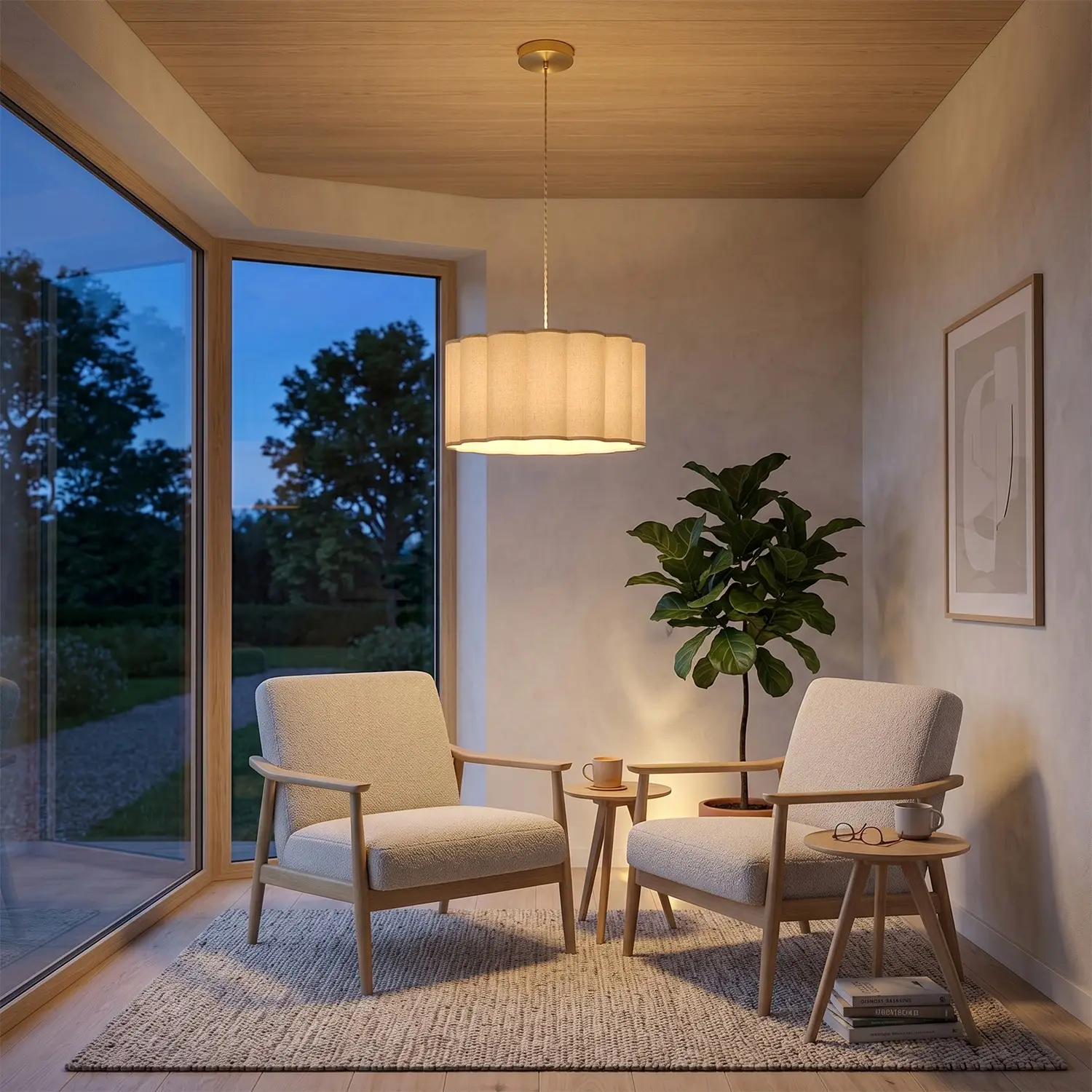
Commercial fabric ceiling light specifications: Sourcing high-end textile lighting requires balancing architectural aesthetics with strict safety protocols, including NFPA 701 and ASTM E84 compliance. This guide details how to evaluate structural integrity, thermal dissipation, and optical transmission to ensure long-term performance in high-traffic commercial environments.
The Engineering Dilemma: Aesthetics vs. Thermal Efficiency in Fabric Lighting
In our production line, we often encounter the friction between the soft, diffused look of textile shades and the harsh realities of LED thermal management. Achieving a sophisticated aesthetic in a Ceiling Light requires precise material selection. When light sources are enclosed, the fabric acts as a thermal blanket, potentially trapping heat that degrades diodes prematurely. The key is engineering a housing that maintains structural elegance while facilitating active airflow.
Textiles in the Plenum: Navigating NFPA 701 and ASTM E84 Compliance
For corporate plenum installations, safety is the primary constraint. We utilize textiles tested under ASTM E84 Surface Burning Characteristics to ensure low flame spread and smoke development. Our third-party test results verify that our standard fabric batches meet the rigorous NFPA 701 standards for flame propagation. During factory audits, we prioritize batch-to-batch consistency in fire-retardant chemical treatment to guarantee that every square meter installed meets the same safety threshold.
Fabric Porosity and Heat Dissipation: Protecting Your LED Lifecycle
Heat accumulation is the leading cause of lumen depreciation. We calculate the textile-to-LED gap ratio to ensure effective thermal dissipation. For instance, in our Fabric Pendant Lights, we incorporate heat-sink housings that leverage convection currents through the weave porosity. Our internal lab report (Data ID: LM-50K-2023) demonstrates that when maintaining a specific air-gap geometry, our fixtures sustain 90% lumen output over 50,000 hours of operation. Do not rely on generic specs; verify that the specific fabric weight used in your Flame Retardant Fabric Commercial Lamp is compatible with the heat sink’s projected thermal load.
Anti-Sag Engineering: Ensuring Structural Integrity in Large-Scale Installations
Large-format panels are prone to sagging over time, which compromises both the visual symmetry and the optical distance from the light source. From manufacturing thousands of units, we have perfected a proprietary high-tension framing system using anti-warp bracketry. This system ensures that the fabric retains its original tension, preventing sagging even in humid office environments. When specifying models like the JY30321, the internal frame structure is designed to isolate the fabric tension from the electrical components, maintaining a consistent appearance throughout the product lifecycle.
Optical Transmission: Balancing Texture Depth with Uniform Light Diffusion
The weave of the fabric significantly impacts the spectral power distribution. Tight, heavy-weight weaves provide excellent hot-spot suppression but reduce light transmission efficiency. Our engineering team utilizes spectral power distribution charts to select fabrics that offer a balance—hiding the LED point sources while maintaining a high CRI (>90) output. For models like the JM30364, we test the weave porosity to ensure the color temperature remains consistent across the entire surface of the diffuser.
Clean-in-Place (CIP) Requirements: Selecting Fabrics for High-Traffic Commercial Zones
Maintenance in hospitality or high-traffic corporate zones requires durable, dust-resistant textiles. We recommend fabrics with hydrophobic coatings that resist particulate accumulation. Always consult our Optimizing Maintenance Fabric Pendant protocols before applying any cleaning agents, as harsh chemicals can degrade the fire-retardant finish and alter the fabric's structural tensile strength.
Technical Specifications and Lab Data Summary
| Parameter | Specification | Performance Note |
|---|---|---|
| Fire Compliance | ASTM E84 & NFPA 701 | Class A Fire Rated Fabrics |
| Lumen Maintenance | 50,000 Hours | LM-50K-2023 Verified |
| Model JY30321 Power | 3 x 7W (E27) | Optimized Thermal Housing |
Need Technical Documentation?
Download our latest compliance dossiers and technical specification sheets for large-scale procurement.
Request Spec SheetFrequently Asked Questions
Q: Which fire certifications are required for commercial ceiling lighting?
A: Most commercial building codes require fabrics to meet NFPA 701 for flame propagation and ASTM E84 for surface burning characteristics to ensure occupant safety in plenum spaces.
Q: How does fabric density affect LED lifespan?
A: Higher density weaves restrict airflow. If the gap between the LED and the fabric is not calculated to allow sufficient convective cooling, heat builds up, significantly reducing the 50,000-hour rated lifespan of the diodes.
Q: What makes your anti-sag framing effective for large installations?
A: Our proprietary tension-mount assembly uses reinforced bracketry that maintains constant tension on the fabric regardless of environmental changes in humidity, preventing warping over the life of the fixture.
Q: How should fabric shades be cleaned?
A: Fabrics should be cleaned according to specific manufacturer protocols provided with the fixture, typically involving low-pressure air dusting or gentle vacuuming, to avoid damaging the flame-retardant chemical treatment.
Q: Can color consistency be guaranteed for large-scale projects?
A: Yes, by utilizing batch-tested textiles, we ensure color uniformity within Delta E tolerances, providing a seamless visual transition across expansive ceiling installations.
Consult Our Engineering Team
Discuss your next high-end interior lighting project requirements with our technical specialists.
Request a Quote