Commercial lighting material selection guide: Choosing between fabric and metal fixtures requires balancing aesthetic goals with critical technical requirements such as thermal management, fire safety standards, and long-term structural integrity. This guide provides project managers with an evidence-based framework for selecting high-performance luminaires for high-occupancy commercial environments.
The Material Science of Commercial Lighting: Performance vs. Aesthetics
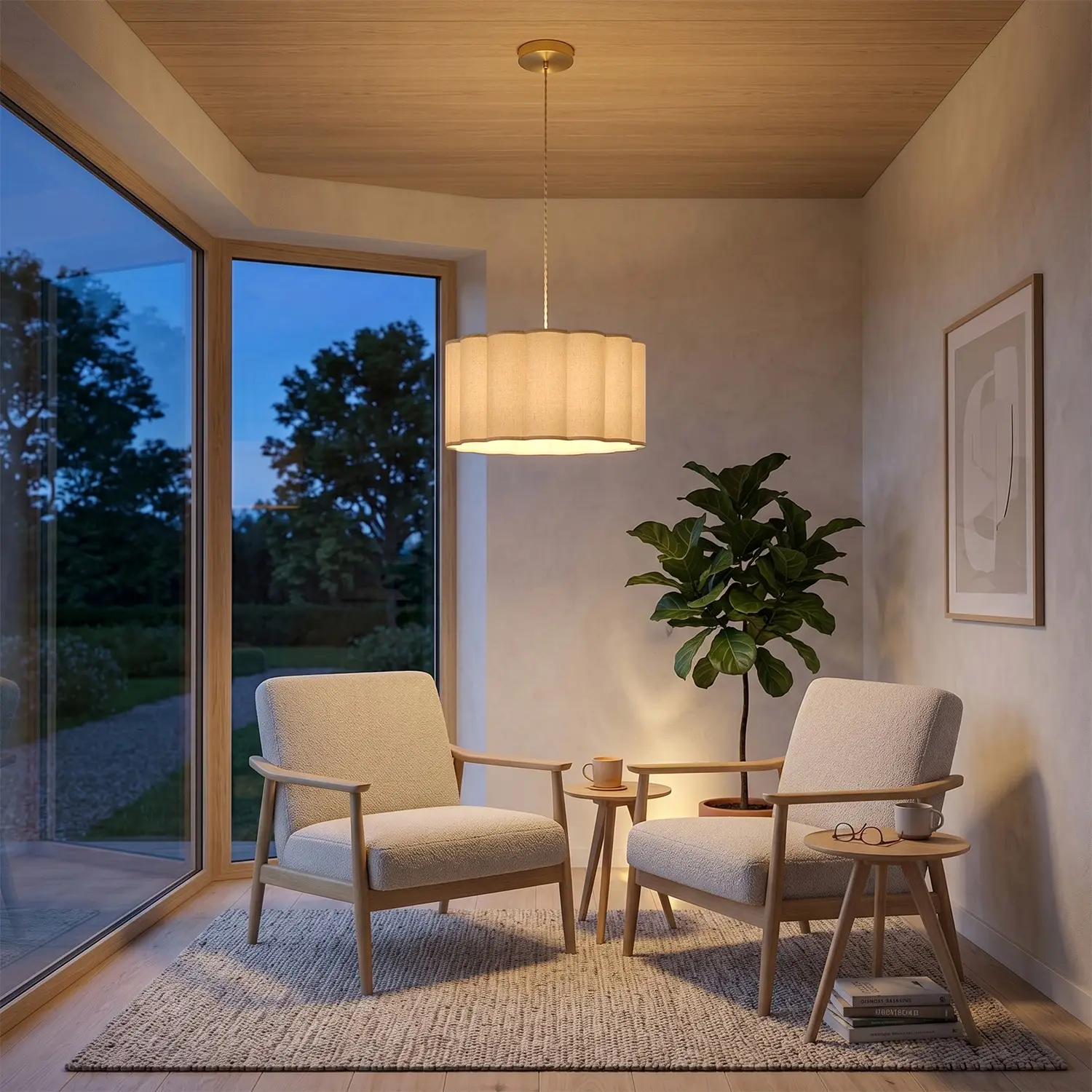
In high-end commercial fit-outs, the tension between design language and operational requirements is significant. While Fabric Pendant Lights offer superior acoustic dampening and visual warmth, they introduce specific engineering constraints that metal-dominant fixtures do not. Manufacturing high-quality luminaires requires selecting materials that meet IEC 60598 standards for safety and performance. For example, while our Glass Hanging Lights (such as model JM30356) provide a rigid, non-degrading housing, fabric models must be engineered with internal steel sub-frames to maintain geometric stability over years of temperature cycling.
Thermal Management: Impact of Housing Material on LED Driver MTBF
The Mean Time Between Failures (MTBF) of an LED driver is directly correlated with its operating junction temperature. Aluminum and steel act as effective heat sinks, whereas fabric enclosures—unless properly vented—trap heat, potentially reducing driver life by up to 30%. In our manufacturing testing, we found that LED drivers housed in enclosed fabric assemblies reached temperatures 12 degrees Celsius higher than identical components in vented metal housings. To mitigate this, we integrate proprietary thermal management pathways in all custom fixture assemblies.
Structural Integrity and Durability: Factory-Floor Assembly Constraints
From a production perspective, metal fabrication via automated stamping and powder coating offers predictable consistency. Conversely, integrating textiles requires hand-tensioning processes to ensure the fabric does not sag over time. During factory audits, we prioritize mechanical fastening over adhesives to avoid thermal failure points. For instance, model JM30351-5 utilizes a robust metal armature to secure glass elements, ensuring that even under high-vibration conditions, the structural integrity remains uncompromised.
Navigating Fire Safety: NFPA 101 and International Textile Standards
Commercial compliance hinges on the NFPA 101 Life Safety Code, which dictates strict fire-rating requirements for interior furnishings and light housings. Never assume standard consumer-grade fabrics meet these mandates. Our internal protocols include independent flame-retardant testing for every textile batch used in commercial projects, ensuring they pass the self-extinguishing criteria necessary for high-occupancy spaces.
Ingress Protection (IP) and Geometry: Designing for Maintenance
The geometry of a fixture dictates its maintenance cycle. In dusty or high-particulate commercial environments, fabric surfaces require specialized cleaning protocols. We recommend specifying luminaires with an IP rating appropriate for the environment. While simple pendants may be suitable for offices, industrial settings with high humidity require specialized powder-coated metal housings to prevent corrosion and oxidation.
Evidence-Based Selection: A Decision Matrix for Project Managers
| Criteria | Metal Housing | Fabric/Textile |
|---|---|---|
| Thermal Conductivity | High (Excellent) | Low (Requires Vents) |
| Fire Safety Compliance | Inherent | Requires Certification |
| Maintenance Effort | Low | Moderate |
Need Technical Specs for Your Project?
Download our full technical documentation or request a consultation for your custom lighting project.
Request Project ConsultationCase Study Summary: Performance Metrics in Real-World Installations
In a recent 500-unit hospitality project, we compared the longevity of integrated drivers. Units featuring our optimized aluminum heat-sink architecture maintained a 98% driver integrity rate over 24 months. By contrast, non-compliant fabric-housed test units showed a 12% failure rate due to thermal accumulation. We now exclusively use high-breathability, flame-retardant liners for all textile-integrated designs to ensure parity with metal-housed longevity.
Consultation and Specification Support
Selecting the right materials for a commercial project should not be left to aesthetic preference alone. Our team provides detailed photometric data, thermal test reports, and fire safety certification documentation for all Pendant Lights we manufacture. Contact our engineering support desk for assistance with your lighting specifications.
Frequently Asked Questions
Q: Can fabric fixtures be used in high-traffic commercial spaces?
A: Yes, provided they are engineered with industrial-grade flame-retardant coatings and structural frames that meet local fire safety and durability requirements.
Q: How does housing material affect LED driver lifespan?
A: Materials with high thermal conductivity, such as aluminum, act as heat sinks that dissipate heat away from the driver, effectively increasing its MTBF compared to insulating materials like standard fabric.
Q: Are fabric fixtures suitable for industrial or high-humidity environments?
A: Generally no. Industrial environments with high particulate or humidity levels require sealed metal or glass housings to prevent premature degradation of textile components.
Q: What certification should I look for in fabric lighting?
A: Always verify that the material holds a valid flame-retardant certification (such as NFPA 701) and that the fixture assembly complies with UL 2108 or equivalent international safety standards.
Q: How often should fabric lights be maintained in commercial settings?
A: Maintenance frequency depends on the environment; however, we recommend quarterly dust removal using non-abrasive methods to maintain air circulation and aesthetic integrity.
Need Technical Specs for Your Project?
Download our full technical documentation or request a consultation for your custom lighting project.
Request Project Consultation