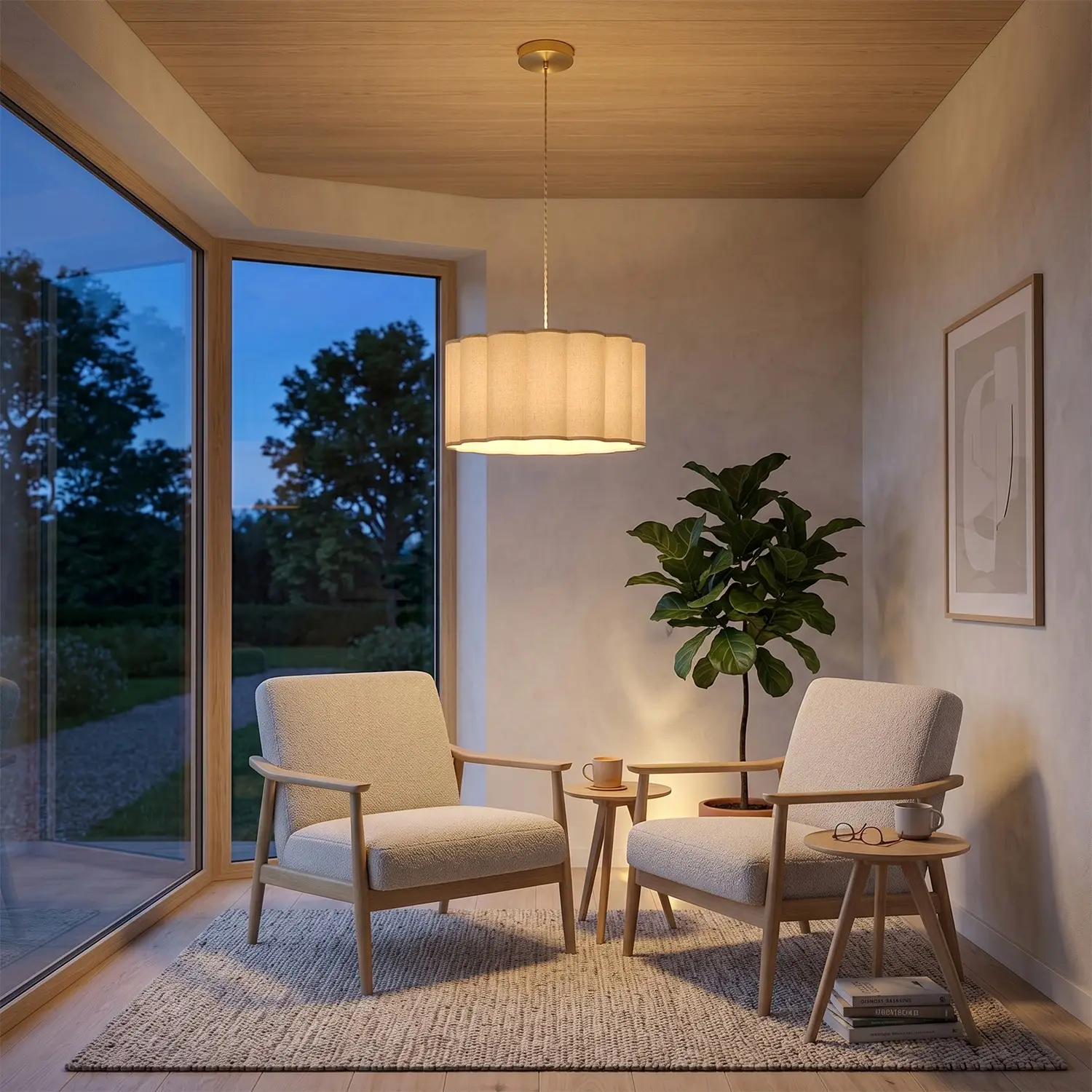
Selecting Commercial-Grade Fabric Pendant Lights: Procurement for hospitality projects requires prioritizing textile tensioning systems, field-replaceable LED light engines, and verified NFPA 701 fire-retardant compliance. By shifting from disposable retail-grade fixtures to engineered commercial luminaires, procurement teams can significantly reduce total cost of ownership while ensuring long-term aesthetic and safety performance in high-traffic environments.
The Hidden Costs of Retail-Grade Lighting
In high-traffic hospitality settings, the initial purchase price of a light fixture is often the least significant factor in the total cost of ownership (TCO). Retail-grade Fabric Pendant Lights often utilize integrated LED modules that are not field-serviceable. When an internal driver fails—frequently accelerated by the heat buildup inherent in enclosed fabric shades—the entire fixture must be decommissioned, creating unnecessary waste and significant replacement labor costs.
Material Science: Weave Density and Tensioning
Aesthetic degradation is the primary failure point for fabric shades in hotels. During our factory assembly process, we utilize precision tensioning jigs to ensure that fabric substrates maintain their geometric form under varying humidity levels. Using high-density polyester blends rather than loose natural fibers is crucial. Polyester blends exhibit superior resistance to stretching, maintaining a crisp profile during high-frequency cleaning cycles. In contrast to lightweight residential models, commercial-grade fabrics undergo a Martindale rub test to ensure the textile does not lose its structural integrity or color vibrancy over thousands of hours of operation.
Beyond Illumination: Acoustic Dampening
Modern hospitality design demands multifunctional elements. Commercial Fabric Pendant Lights function as acoustic baffles when paired with high-performance inner core liners. By engineering the shade thickness and porosity, we can achieve measurable sound dampening in large, hard-surface lobby areas. These units are tested to ensure that the fabric weave density provides a Noise Reduction Coefficient (NRC) rating sufficient to mitigate echoing in open-plan dining and reception spaces.
Technical Specs: Heat Management and Lumen Consistency
Proper heat management is vital for extending the lifespan of LED engines. For instance, our Fabric Pendant Light variants are designed with ventilated top caps that promote convective airflow. While glass-based units such as our Model JM30356 (measuring Ø30 × H100 CM) rely on material-inherent heat dissipation, fabric shades require internal diffusers to prevent hot spots and ensure uniform light output. Our testing protocols verify that light transmission rates remain within 5% of rated output after 5,000 hours of continuous operation.
Ease of Maintenance: Field-Replaceable LED Engines
Our commitment to long-cycle maintenance is evidenced by our modular design approach. Unlike retail fixtures, our commercial products, including models like JM30364 (E27 base, 110-240V compatibility), are built to allow maintenance teams to replace the light engine without dismantling the entire shade structure. This is essential for maintaining the high standards required in international hotel chains where facility downtime must be minimized during maintenance cycles.
Compliance Checklist: NFPA 701, UL/cUL, and Structural Load Testing
Safety is the foundational requirement for any commercial lighting project. We adhere to NFPA 701 standards for all fabric batches, ensuring rigorous flame-retardant performance. Additionally, our mounting hardware undergoes vibration and load-bearing stress tests, simulating high-traffic, ceiling-mounted environments. All electrical components are constructed to meet UL 2108 low-voltage lighting standards to ensure compliance with global safety regulations.
Selecting the Right Mounting Hardware
In hospitality, especially in multi-story hotels, the mounting system must accommodate ceiling vibration without compromising the fixture's vertical alignment. We utilize reinforced steel cable grips tested for loads exceeding 3x the weight of the fixture to ensure structural safety. Our engineering team confirms that hardware configurations for our series, including the Glass Hanging Lights like JM30351-5 (Ø49 × H110 CM), are fully rated for commercial structural applications.
Procurement Strategy: Aligning Factory Specs
When selecting fixtures, ensure your procurement team requests specific fire-retardant certificates and lumen depreciation reports rather than relying on standard retail data sheets. Reviewing these documents during the vetting phase of Hospitality Fabric Pendant Technical procurement ensures your project meets the life-safety requirements mandated by local inspectors.
| Feature | Retail-Grade | Contract-Grade |
|---|---|---|
| LED Maintenance | Integrated (Disposble) | Field-Replaceable Engine |
| Safety Certification | Basic CE/UL | NFPA 701, UL/cUL Verified |
| Fabric Tensioning | Standard glue/sew | Precision Tensioning Jig |
Need Certified Specification Data?
Request our comprehensive project-specific spec sheets and full NFPA 701 fire-retardant certification documentation.
Request a QuoteFrequently Asked Questions
Q: What is the importance of NFPA 701 compliance for fabric lights?
A: NFPA 701 confirms the fabric meets standard fire-retardant testing requirements, which is mandatory for fire safety compliance in commercial hospitality and public building projects.
Q: Can fabric shades be cleaned in commercial settings?
A: Yes, contract-grade fabrics are designed for high-frequency maintenance. We recommend using specific cleaning agents compatible with the weave density of the selected textile.
Q: Why choose field-replaceable LED engines?
A: They significantly lower operational costs by allowing maintenance staff to replace failed components rather than discarding the entire fixture assembly.
Q: How does tensioning prevent sagging?
A: Our precision tensioning systems use internal structural frames to maintain consistent fabric tautness, preventing the warping often caused by humidity in high-traffic hotels.
Q: What are the structural requirements for mounting these lights?
A: All fixtures must be installed using hardware rated for the specific ceiling type. We provide stress-test documentation for our mounting systems to ensure safe deployment in high-vibration areas.
Optimize Your Hospitality Project
Contact our engineering team to compare our commercial-grade models for your next installation.
Compare Models