Thermal management for LED fabric luminaires: Achieving long-term performance in fabric-enclosed fixtures requires an engineered approach to heat dissipation. By integrating internal heat sinks and utilizing thermal bridge construction, manufacturers can maintain safe junction temperatures, preventing the premature driver failure and lumen degradation common in aesthetic-first designs.
The Engineering Paradox: Balancing Textile Aesthetics with LED Thermal Requirements
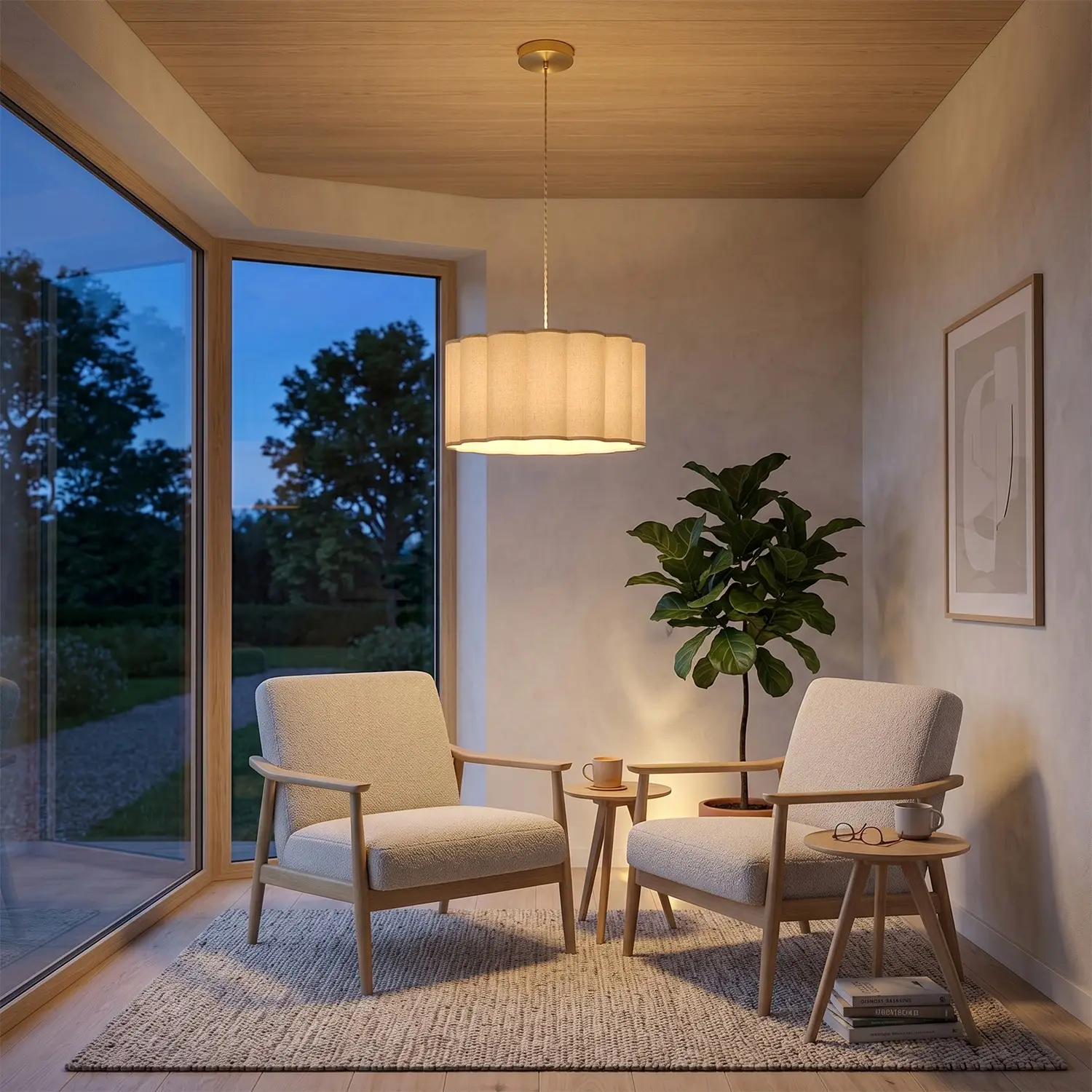
In high-end commercial interiors, the marriage of soft textiles and high-output LED technology creates a significant engineering challenge. While designers prioritize the diffuse quality of light offered by Fabric Pendant Lights, the physics of heat dissipation in enclosed volumes often contradicts these visual objectives. At our manufacturing facility, we recognize that fabric acts as a thermal insulator, effectively trapping heat and shortening the lifespan of sensitive electronic components. To counter this, we treat thermal management not as an afterthought but as a core requirement of the assembly process.
Heat Dissipation Mechanics in Enclosed Fabric Fixtures: Understanding Thermal Bridges
The primary failure point in decorative lighting is the LED driver, which often suffers from heat soak in fixtures lacking ventilation. In our Fabric Pendant Light production lines, we implement proprietary thermal bridge construction. This involves creating a conductive path—often using aluminum heat-sink interfaces—that transfers energy from the LED junction directly to the external metal chassis, bypassing the fabric shade entirely. This prevents the heat from pooling near the driver, an essential practice as detailed in the IEC 60598-1 luminaires safety standards.
Evaluating Fabric Porosity: Why Material Density Impacts Lumen Maintenance and Lifespan
Fabric porosity is directly proportional to internal ambient temperature rise. Dense materials restrict airflow, leading to rapid lumen degradation. When we manufacture series like the JM30364, we conduct rigorous heat-map validation to determine if a specific textile weight requires additional convection ports. Without this, standard Pendant Lights will fail to reach their rated L70 hours. Our data shows that for every 10-degree Celsius increase above the driver's rated ambient operating temperature, the failure rate increases by approximately 50 percent.
Safety Protocols for B2B Procurement: Beyond Aesthetic Specifications
Procurement managers must look past surface-level aesthetics. Safety certifications, such as the CE marking, are vital indicators of compliance with material flammability protocols. In our facility, we perform 24-hour burn-in tests as a standard QC pass-fail criterion. This ensures that internal temperatures in areas of thermal contact do not exceed the critical heat-deflection point of the housing materials. We do not claim fabric is fireproof; however, our assemblies are engineered to be heat-resistant, ensuring safety in continuous-operation commercial applications.
Our Laboratory Approach: How We Validate Thermal Performance in the JM Series
Our commitment to precision is evident in our development of the JM30364 linen series. By utilizing LM-80 certified LED modules, we ensure predictable lumen maintenance. During production audits, we compare prototype performance against verified thermal imaging snapshots to ensure internal heat-sink alignment. For example, while comparing the thermal profile of our glass series like the Glass Hanging Lights against our fabric line, we have established that the JM30356 requires distinct heat-dissipation geometry due to its metal-to-glass interface, which acts as a radiator, unlike the textile shades of the JM30364.
| Feature | Standard Decorative Fixture | JM-Series Engineered Fixture |
|---|---|---|
| Heat-Sink Integration | Absent or Passive | Active Thermal Bridge |
| Burn-in Verification | None | 24-Hour Thermal Mapping |
| Safety Certification | Basic Electrical Safety | CE-Compliant Thermal Housing |
Need Technical Validation?
Request our complete technical spec sheets, including LM-80 reports and thermal testing data for the JM series.
Request Spec SheetSpecification Checklist for Bulk Procurement of Fabric-Shade Pendants
When sourcing for hospitality projects, ensure your RFQ includes the following criteria:
- LM-80 testing reports for all included LED modules.
- Documentation confirming internal housing material is heat-resistant.
- Confirmation of thermal dissipation testing via laboratory heat-map imaging.
- CE certification specific to the integrated electrical and thermal assembly.
Frequently Asked Questions
Q: How does fabric density affect the thermal derating of integrated LED modules?
A: Higher fabric density restricts natural air convection, leading to higher localized ambient temperatures. This necessitates a lower drive current or advanced internal thermal bridging to ensure the LED module remains within its recommended operating junction temperature.
Q: What are the recommended clearance distances between LED heat sinks and internal fabric liners?
A: We recommend a minimum clearance of 20mm to 30mm for natural convection, depending on the wattage and the specific porosity of the textile, to prevent long-term thermal fatigue.
Q: Which fire-retardant materials for fabric pendants maintain optimal thermal conductivity?
A: Glass-fiber-based textiles and treated synthetic linens are generally preferred. They offer the necessary heat resistance while being engineered for consistent porosity to support air movement.
Q: How do you calculate the junction temperature (Tj) rise in enclosed fabric shade fixtures?
A: Tj is calculated using the ambient temperature inside the shade plus the product of the power dissipation and the thermal resistance (Rth) of the heatsink and mounting assembly.
Q: What specific ventilation design features prevent premature LED driver failure in decorative fabric pendants?
A: We incorporate top-venting baffles and thermal conductive paths that move heat away from the driver enclosure, ensuring the electronic components operate within their rated thermal envelope.
Need Technical Validation?
Request our complete technical spec sheets, including LM-80 reports and thermal testing data for the JM series.
Request Spec Sheet